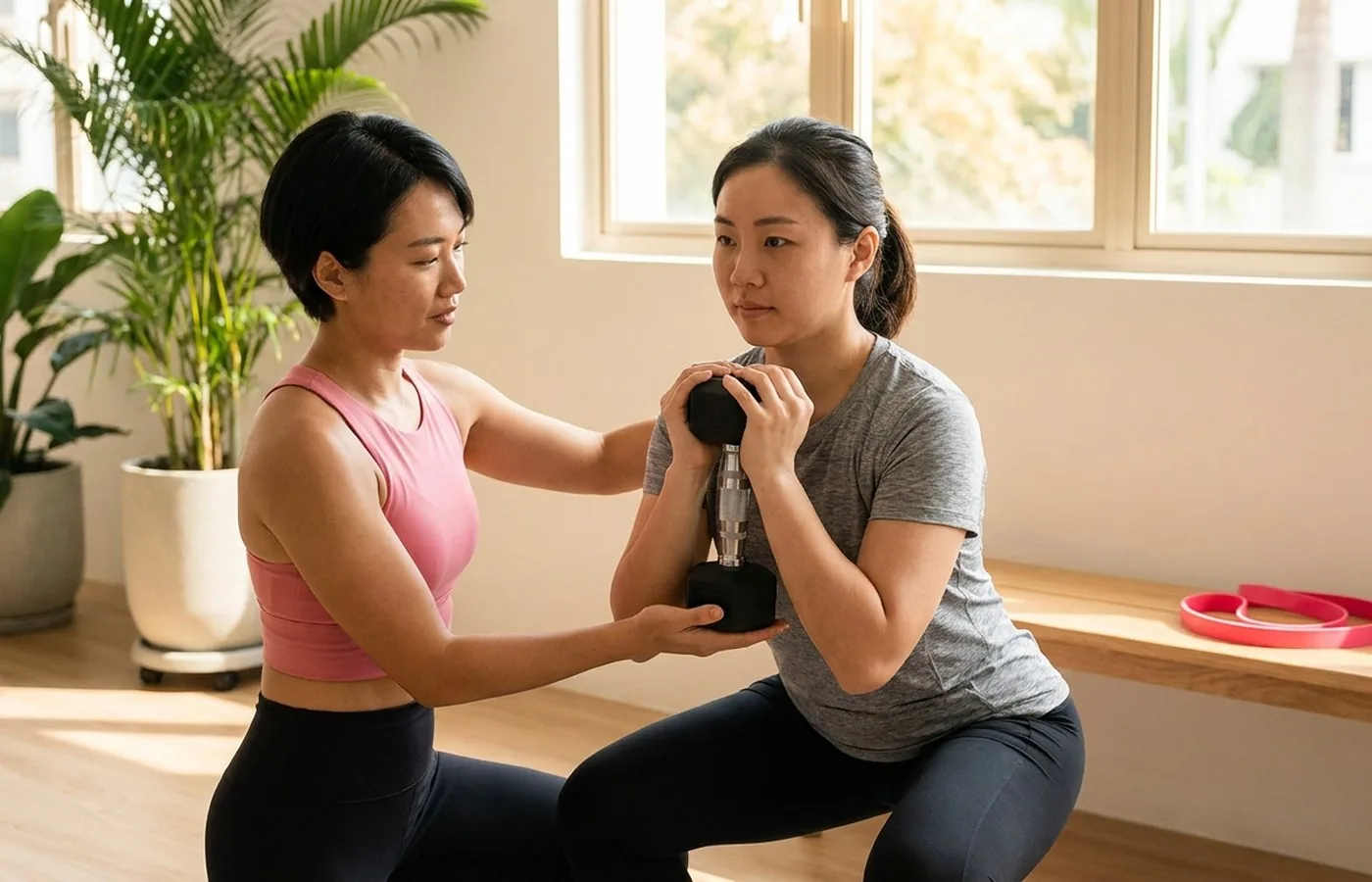
Your first strength plan should feel clear, not scary. Start light, learn five basic movements and build one small step at a time.
Key points
- Train two or three non-consecutive days each week.
- Finish most sets feeling you could do two more good repetitions.
- Add repetitions before you add weight.
- Consistency and technique matter more than soreness.
Start with movements, not machines
A useful beginner programme covers five patterns: squat, hinge, push, pull and carry. Between them they cover most of what you ask your body to do outside the gym: standing up off a low sofa, hauling groceries up stairs. You can learn all five with body weight, dumbbells or resistance bands. Choose the version that lets you keep a steady trunk and a smooth tempo; the exercise does not need to look advanced to be effective. A chair squat done well teaches more than a barbell squat you cannot control, and that skill carries over when you add load later.
If putting those five patterns in an order feels like the hard part, the Workout Builder will lay out a session for the time and equipment you have on the day.
What you need to start
Less equipment than most training videos suggest. One pair of adjustable dumbbells, a set of resistance bands or a sturdy chair will cover the first month. A gym adds heavier loads, machines and a space that is not your living room, which some people find makes them turn up. Neither option is better in general. What matters more is whether the kit is within reach on a Tuesday evening when you are tired and it is raining. If you are buying, one adjustable pair beats a rack of fixed weights you will outgrow, and bands pack into hand luggage.
If you are leaning towards the gym and have not been inside one before, our guide to a first gym visit covers the sign-in rules, the floor layout and how to set up a machine you have never used.
Use this as a starting point, then adjust for your body, conditions and professional advice. A plan is useful only when it responds to you.
A simple first-week session
Warm up with five minutes of easy movement. Complete two sets each of a chair squat, dumbbell deadlift, incline push-up, one-arm row and suitcase carry. Aim for 8 to 12 controlled repetitions, resting long enough that your breathing settles before the next set. The whole thing should take around half an hour including the warm-up. Do it twice in the first week, on days that are not back to back. Resist adding exercises because it felt short. A session you can repeat on Thursday is worth far more than one that leaves you lowering yourself gingerly onto chairs.
On weeks when half an hour is not available, the 20-minute full-body circuit runs through the same patterns with a chair and a loaded backpack, which keeps the habit intact until the schedule loosens.
Choosing a weight you can control
Pick a load that lets you finish the set with about two good repetitions still available. The last one should look like the first: same speed, same shape, no held breath and no twisting sideways to get it up. If the final repetition turns into a fight, the weight is too heavy for today. If you reach the top of the range and could comfortably do five more, go up. Beginners often guess too light for the legs and too heavy for the shoulders, so expect to change your mind in the first few sessions. That is information, not a false start.
How to progress
Add one or two repetitions before adding load. When every set feels crisp at the top of the range, move to the next-smallest weight available and return to the lower end. Small jumps beat brave ones: 6kg to 7kg keeps the movement intact, while leaping to 10kg usually turns a clean squat into a slow struggle. Expect the numbers to sit still for stretches, especially on pressing movements, and expect to repeat a week after illness, travel or a run of poor sleep. Strength arrives unevenly, and a flat month with good technique is still a month of training.
Recovery is part of training
Muscles adapt between sessions, not during them. Regular meals, adequate protein, sleep and easy walking support that process better than chasing exhaustion. Soreness a day or two after an unfamiliar exercise is common and usually settles on its own; it tells you something was new, not that the session worked. Leave at least a day between workouts that train the same muscles, and take the rest day in the weeks when you feel fine as well. Sharp pain, dizziness, chest discomfort or symptoms that feel unusual are reasons to stop and seek qualified advice.
Both halves of that are worth reading about properly. Our guide to protein for active women shows what a useful serving looks like at each meal without weighing anything, and the sleep and recovery guide explains why a run of broken nights shows up in the next session before it shows up anywhere else.
When a movement does not suit you
Every exercise has a version that fits. If squatting bothers your knees, try a higher chair, a shorter range or a supported split squat. If pressing overhead pinches a shoulder, press at an angle instead. Sore wrists during push-ups often settle when you hold dumbbells rather than flatten your palms on the floor. Swapping a movement is an ordinary coaching decision, not a step down. What is not ordinary is pain that sharpens as you keep going, joint pain that lingers for days, or numbness travelling down an arm or leg. Those belong with a physiotherapist or doctor.
What your first month should feel like
Week one is for learning where your feet, hands and equipment go. Keep the weights easy and leave the gym feeling as though you could repeat the session. In week two, aim to make the same movements smoother. During week three, add a repetition to a few sets if your form stays steady.
In week four, keep the exercises and add the smallest available load only where the full repetition range feels controlled. A little muscle tiredness is normal, but sharp joint pain is not a sign that training is working. Record the exercise, load and repetitions after each session. Those notes stop you from guessing and show progress that a mirror may not reveal.
If sleep, work stress or illness makes a week harder, repeat it rather than jumping ahead. Four calm weeks build more useful skill than one punishing workout followed by a long break.
Build your first strength-training week
Turn the movement basics into a plan you can repeat.
- Create a beginner strength workoutChoose your time and equipment.
- Use the 20-minute home sessionPractise the same patterns without a gym.
- Make training easier to repeatSet a minimum version for busy weeks.
This article provides general education and is not a diagnosis or a substitute for personalised medical care. Stop exercise and seek appropriate help for severe, sudden or concerning symptoms.
Strength Training for Beginners: Your First 4 Weeks: questions answered
Do I need a gym?
+
No. A pair of dumbbells or bands can provide months of useful progression.
How heavy should I lift?
+
Use a load you can control while keeping roughly two repetitions in reserve.
Will strength training make me bulky?
+
Muscle gain is gradual and depends on training volume, food and individual biology. Most beginners first notice improved confidence and capacity.
How long before I notice a difference?
+
Many people feel steadier and lift a little more within the first few weeks, largely because the nervous system learns the movements. Visible change takes longer and depends on training, food, sleep and individual biology.