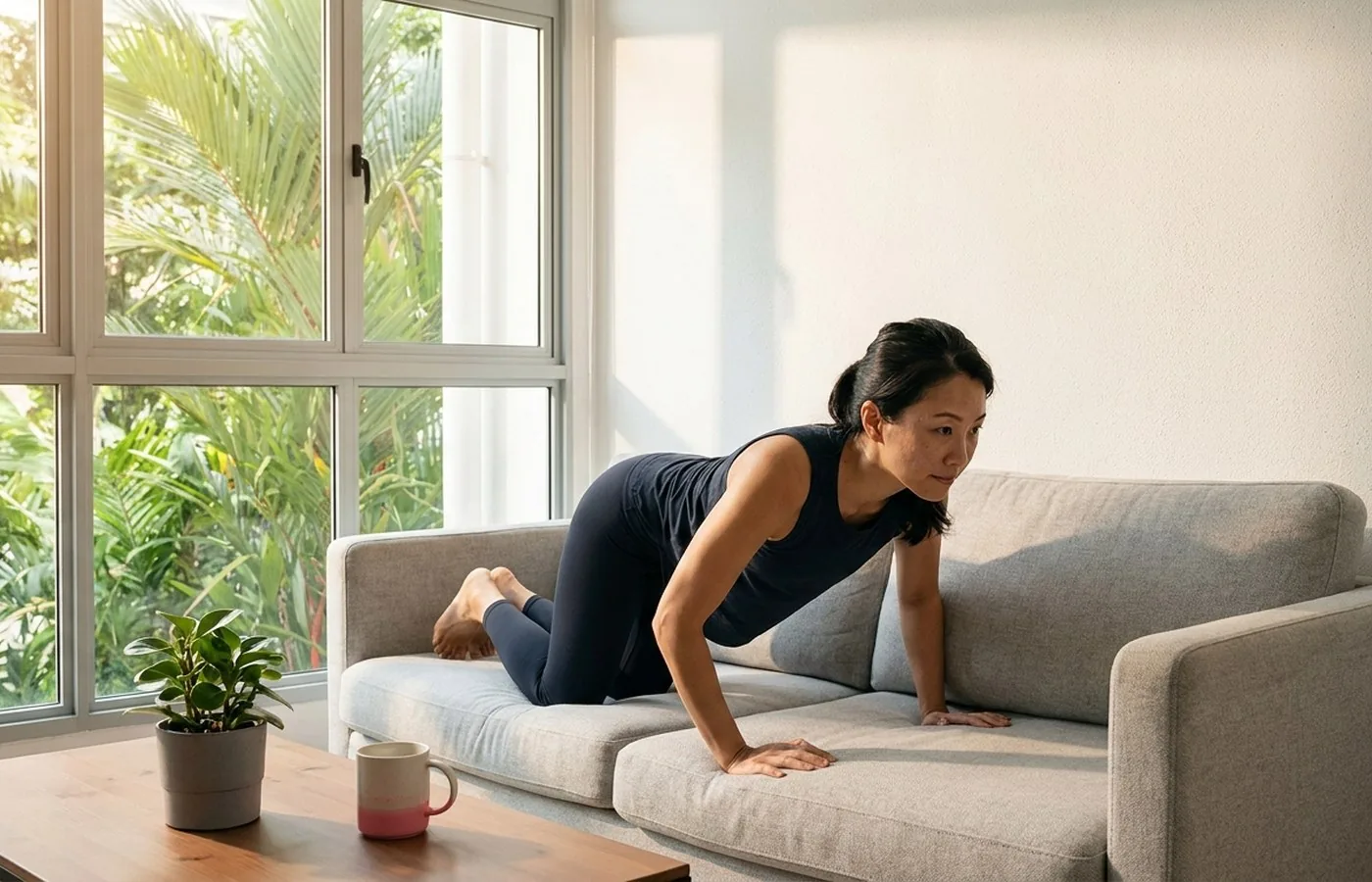
A short workout can still train your whole body. This one uses five simple moves and gives you easier options when energy is low.
Key points
- Use a timer for 40 seconds of work and 20 seconds of transition.
- Keep the impact optional so it works in any flat.
- A short completed session beats a perfect plan you cannot repeat.
- A chair, a loaded backpack and floor space are the whole kit.
The warm-up
March in place, roll the shoulders and practise slow squats for three minutes. The goal is to feel warmer and move through comfortable ranges, not to tire yourself out. Add easy hip swings if you have spent the day in a chair. Three minutes sounds like nothing, and that is the point: you want to reach the first squat already breathing a little harder and already moving the joints the circuit will use. Skipping it saves no real time and makes the opening round feel worse than the last.
The circuit
Rotate through squats, incline push-ups, reverse lunges, backpack rows and a dead bug. Complete three rounds. Use a stable table or wall for the push-up and shorten the lunge if balance is a challenge. A few cues carry most of the quality. Sit back into the squat as though the chair were still behind you. Step backwards rather than forwards into the lunge to keep the front knee quiet. Pull the backpack towards your hip, not your chin, and press your lower back into the floor before moving a limb in the dead bug.
Those five moves are the squat, hinge, push, pull and carry patterns that a beginner strength plan is built on, so none of this becomes redundant if you later add dumbbells or join a gym.
Use this as a starting point, then adjust for your body, conditions and professional advice. A plan is useful only when it responds to you.
Kit you already own
Nothing here needs a shop. A dining chair or the arm of a sofa gives you a squat target and a surface to press against. A backpack filled with books, rice or water bottles works as an adjustable weight; tighten the straps so the load sits close and does not swing. A folded towel is kinder on the knees than a hard floor. A band adds an easy way to load the rows, though the bag will do that job for a long time.
If you would rather not decide the running order yourself, the Workout Builder will put a session together around the chair, the bag and the floor space you have.
Set the clock before you start
Choose the work-to-rest split first and let the timer make the rest of the decisions. Forty seconds of work with 20 to change position suits most people. Newer exercisers often do better with 25 seconds on and 35 off, which leaves room to set up between moves. A free interval-timer app calls the changes out loud so you are not squinting at a screen mid-lunge. Counting repetitions works too, though a clock stops the rests stretching while you check a message.
Making that decision once, before you begin, is the same move the fitness-habit guide recommends for the session as a whole: settle the details in advance so a tired evening has nothing left to negotiate with.
Keeping it quiet in a flat
A home workout has neighbours. You can train the whole body without a single jump: step-backs instead of jumping lunges, brisk marching instead of high knees, and a slow squat that asks plenty of the legs on its own. Land softly on the days you do want impact, put a mat down to take the edge off, and think about the hour before you start bouncing above someone's bedroom. None of this makes the session easier; controlled repetitions with a heavier bag usually beat bouncing.
Cool down
Walk slowly around the room until your breathing eases, then spend a minute on whatever feels tight. You do not need an elaborate stretching ritual after every session. A calf stretch, a hip opener and a doorway chest stretch are plenty. Wait a little before showering if the room is warm, because you will keep sweating for a while after you stop. Refill your water and put the chair back. Tidying up takes a minute and makes the next session something you start rather than set up.
Plenty of people finish a short circuit feeling calmer rather than fitter, and that is a reasonable thing to train for. The movement-for-stress guide covers using exercise that way without turning it into one more thing to get right.
When to stop or swap a move
Stop for chest pain, dizziness, faintness, or breathing that feels out of proportion to what you are doing, and get advice instead of finishing the round. Sharp joint pain is a signal to change the movement rather than push through it: raise the push-up higher, shorten the lunge, use the squat range you own today. Stiff, aching muscles in the two days after a new session are common and usually settle. Anyone pregnant or recently postpartum, or living with a heart, joint or blood-pressure condition, should ask a clinician which moves suit them.
How to keep a short home workout effective
Set up before the timer starts. Move a chair against a wall, clear the floor and place any backpack or water nearby. During each work period, choose a pace that lets the final repetition look like the first. If form slips after 20 seconds, pause, breathe and continue with an easier version. Progress does not require turning every movement into a jump.
You can lower the chair for squats, make the backpack slightly heavier, use a lower surface for push-ups or add a fourth round. Change only one of those things at a time. On a difficult day, complete the warm-up and one round; that still protects the habit. On a stronger day, use the full session.
The workout is successful when it fits into the week often enough to improve skill and capacity, not when it leaves you unable to use the stairs.
A weekly place for the 20-minute workout
Use this session on two non-consecutive days, or once during a week that already contains other strength work. Easy walking, cycling or mobility can fill the days between. When all three rounds feel controlled for two sessions, progress one movement instead of extending every work interval. This keeps a short workout focused and makes the next improvement easy to recognise.
Make your home workout part of a plan
Use the short session as one piece of a balanced week.
- Generate another home workoutChange the goal while keeping the time realistic.
- Learn beginner strength progressionKnow when to add repetitions or load.
- Put the workout on a seven-day trackerConnect it to a cue that already happens.
This article provides general education and is not a diagnosis or a substitute for personalised medical care. Stop exercise and seek appropriate help for severe, sudden or concerning symptoms.
A 20-Minute Full-Body Workout for Busy Days: questions answered
Can I do this every day?
+
Alternate it with easier walking or mobility days so the same muscles can recover.
What if I cannot do lunges?
+
Use a sit-to-stand or supported split squat instead.
Does 20 minutes count?
+
Yes. Short bouts of activity contribute to weekly movement and are easier to make consistent.
How do I make it harder without adding time?
+
Slow the lowering phase, put more weight in the backpack, or use a lower surface for the push-up. Each of those raises the demand while the clock stays the same.