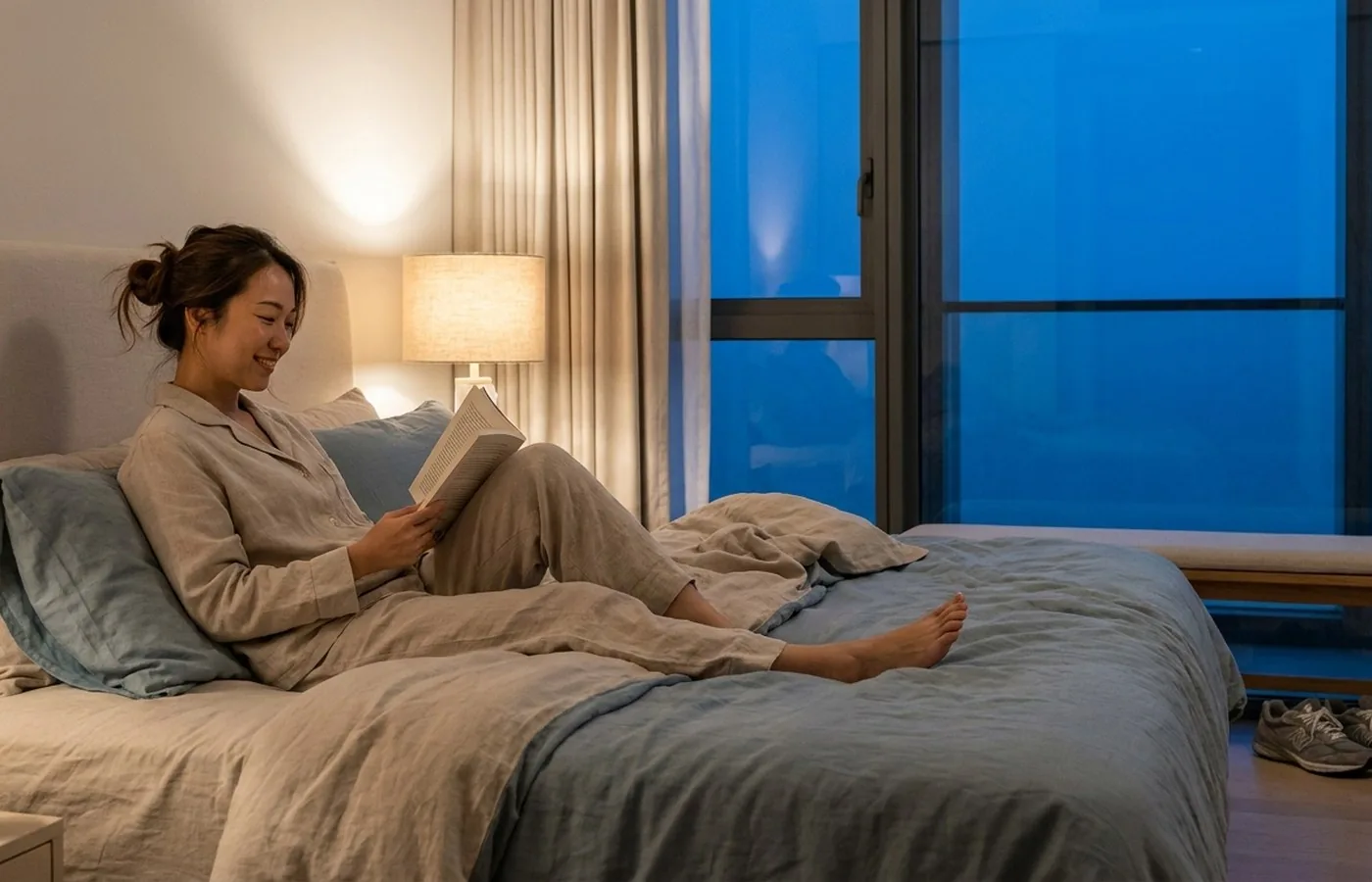
If you have ever lain awake at midnight, sheets already damp, aircon humming, wondering why sleep feels like such a fight here, you are not imagining things. Singapore's climate, density, and always-on pace work against good sleep in specific, fixable ways. This is not about willpower. It is about understanding what is keeping you up and changing the few things that matter most.
Key points
- Heat and humidity make it harder for your body to cool down enough to fall asleep.
- Noise and light from city living can quietly fragment sleep even when you don't wake up fully.
- Late screen use delays your body's natural signal that it's time to sleep.
- A short, repeatable wind-down routine works better than any single gadget or app.
Why Singapore nights fight against your sleep
Your body needs to drop its core temperature by a degree or two before it can settle into deep sleep. In a cool, dry climate that happens fairly easily. In Singapore's heat and humidity, it does not, especially if your bedroom holds onto warmth from the day or your aircon switches off partway through the night and lets the room creep back up. That mismatch between what your body needs and what the room gives it is one of the biggest reasons people here report lying awake or waking up sweaty at 3am.
Living in a dense city adds another layer. Traffic, late-night deliveries, neighbours, construction, and thin walls in older flats all mean your sleep is interrupted by small sounds that may not fully wake you but still drag you out of the deepest, most restorative stages. High-rise living can also mean streetlights and neighbouring windows leaking light through curtains that were never really made for blackout duty.
None of this means good sleep is impossible here. It means the fixes need to match the actual problem. If you want to understand how sleep connects to your training and recovery more broadly, our guide to sleep and exercise recovery is a useful next stop.
The everyday habits quietly making it worse
- Setting the aircon to switch off mid-sleep, so the room warms up right when you need it coolest.
- Scrolling in bed with the screen brightness up, which delays your body's natural sleep signal.
- Drinking coffee or tea later in the afternoon than you realise, since caffeine can linger in your system for hours.
- Eating a heavy, late dinner that leaves your body still digesting when it should be winding down.
- Going to bed at a wildly different time on weekends, which resets your body clock every Monday.
- Exercising very late at night close to bedtime, which can raise your heart rate right when it should be dropping.
Most people are not doing just one of these. They are stacking two or three, which explains why sleep can feel like a losing battle even when someone feels like they are "trying" to sleep well. If your fluid intake through the hot day is also off, the Hydration Planner can help you find a steadier daytime baseline, since being under-hydrated during the day can make you restless at night too.
Use this as a starting point, then adjust for your body, conditions and professional advice. A plan is useful only when it responds to you.
A wind-down routine that works with the heat, not against it
- Set your aircon or fan on a timer that covers your whole sleep window, not just the first hour.
- Take a lukewarm, not ice-cold, shower an hour before bed. It helps your body complete its natural cool-down.
- Dim the lights in your home for the last hour before bed instead of leaving everything on full brightness.
- Put your phone somewhere out of reach, or at least switch on night mode and lower the brightness right down.
- Keep your bedtime and wake time within about the same hour every day, weekends included.
- If your mind is racing, jot down tomorrow's worries on paper instead of turning them over in your head.
This kind of routine is not glamorous, but it works because it removes the small daily fights your body is having with heat, light, and stimulation. Give it one to two weeks before deciding whether it helped. Sleep habits rarely change overnight, even when the changes themselves are simple.
How fixing these sleep problems changes more than just your nights
Poor sleep in a hot, noisy city does not stay contained to bedtime. It shows up the next day as a shorter fuse, slower workouts, and a stronger pull toward sugar and caffeine just to get through the afternoon. Fixing the sleep problem is often the fastest way to fix several smaller daytime problems at once, without touching your diet or your workout plan at all.
Start with whichever piece feels most broken for you right now: the room temperature, the screen habit, or the wildly shifting bedtime. If stress is the real driver behind your racing mind at night, the mind hub has more on managing that side of things. For more restored archive pages like this one, the lifestyle hub is where older SHAPE content on sleep and everyday wellbeing is being rebuilt.
Sleep in Singapore will probably never feel as easy as it does in a cooler, quieter place. But most of what keeps people up here is fixable with a handful of steady changes, not a total life overhaul.
More on this topic from the archive: What Helps With Blackheads (And What Just Feels Satisfying), Why Your Skin Feels Oily No Matter What You Try and How to Take a Vacation That Feels Like a Break.
This article provides general education and is not a diagnosis or a substitute for personalised medical care. Stop exercise and seek appropriate help for severe, sudden or concerning symptoms.
Why Sleep Feels So Hard to Get in Singapore: questions answered
Why do I wake up sweaty even with the aircon on?
+
Often because the aircon switches off partway through the night or the timer doesn't cover your whole sleep window, letting the room warm back up.
Does napping in the day ruin night sleep here?
+
A short nap usually doesn't, but a long or late one can make it harder to fall asleep at your usual bedtime.
Is it the heat or the screens causing most of the problem?
+
It's usually both together. Heat keeps your body from cooling down, while screens delay the signal that tells your brain it's time to sleep.